Thursday, January 24, 2013

Tel Aviv Nightlife Crawl


As seen in Conde Nast Traveler

Tel Aviv Nightlife Crawl

HaOman 17, Tel Aviv
HaOman 17
You won’t need earplugs for Tel Aviv’s latest nightlife sensation: the exhibition “Night Stamp” at the gallery in Beit Ha'ir (the old city hall). The show, mounted by the Tel Aviv municipality itself, is a dip into the legendary exuberance of Tel Aviv’s clubland as dreamt up by nightlife icon Shimon Shirazi. Fittingly, New York’s own Amanda Lepore flitted into town for opening night a few weeks ago.

Many of show's images of frenzied nights were taken (perhaps by the one person not so drunk that he couldn’t hold a camera) at 1 HaOman 17 (88 Abarbanel St.),Tel Aviv’s biggest club. The action starts late inside this former warehouse in the gritty south end of town (note: it’s huge but hard to find, so a taxi is a must). If you’re lucky you’ll be visiting when popular Israeli DJ Offer Nissim is spinning there. Nissim is famous for his dark tribal progressive house beats and mean Madonna remixes—he opened for Madge at the first concert of the MDNA tour, in Tel Aviv, last year.
Some of the best Tel Aviv nights out begin, naturally, with the alcoholic beverage of your choice. Your first stop on the tipple circuit should be any of the large bars around the lower and generally ebullient reaches of Lilienblum Street and Rothschild Boulevard. Or start where the trendy bohos are at 2 Port Sa’id (Har Sinai 2). It’s a groovadelic drinkery that takes its name from the Egyptian coastal town and is located, ironically enough, behind Tel Aviv’s Great Synagogue. Both the interior and terrace fairly ooze retro flair (funky background music emanates from vinyl here) and you can make yours an uncomplicated arak cocktail or beer before moving on to one of numerous watering holes on trendy Nahalat Binyamin Street nearby.

Hot spots there include the newish 3 Soda Bar (Nahalat Binyamin St. 43), where you'll find a healthy serving of sizzling dance sounds and Dr. Pepper-based cocktails, and 4 Shpagat (next door, same address), the city’s new go-to gay spot (more bar than club) in a former ballet studio that offers funky stadium-style seating and modern electro beats pumped out at a decibel level that will not preclude flirting with the abs-olutely fabulous bartender.
Remember that Thursday tends to be the wildest party night in Tel Aviv, because it’s like Fridays most everyplace else (Sunday being a work day in Israel), and that’s when bars and clubs of all stripes really start to fill up. But most any night will do at the 5 Block (157 Salame St.), which, despite its location essentially inside a bus terminal in the shadiest part of town, draws big name international DJs like tinkerer-of-Björk-tunes David Morales. And in a boisterous side street with no remarkable Bauhaus architecture whatsoever you’ll find the 6 Zizi Club (7 Carlebach St.), whose PAG lineline being the local idiom for "themed club party"—on Fridays is the city’s hottest electro night and attracts a loyal, fashion-conscious and not infrequently gender-bending crowd.

The 7 Milk and Breakfast Club (6 Rothschild Blvd.) has nothing to do with either (you expected things to make sense? This is the Middle East!), but is one of the best spots to shake it on the way-after-hours side. It puts on a Thursday line with a loyal gay following. For more of an Arab acoustic flavor hit the 8 Anna Loulou Bar in Jaffa (Hapanini St.) on Wednesdays. Pair wicked libations with equally wicked electronica and hip-hop beats at the underground (literally) 9 Michatronix club (28 Ben Yehuda) or the very hopping and decidedly non-kosher 10 Deli (47 Allenby St.), a secret dance club lurking behind a streetside sandwich counter. And to see just how reluctantly clothing and the dance floor mix in Tel Aviv once the weather warms up—well, check back with me around Passover.

Monday, January 21, 2013

Israel's 65th Anniversary Mission


I have just returned from a 2 week trip to Israel.  The first week I was with a group from the Jewish National Fund.  The second week, I traveled through the country on my own.  This was my tenth trip to Israel, the first being in 1965.  This trip, not in small part because it coincided with Israel's 60th anniversary as an independent state, was the best.  The truth is I always say that my last trip to Israel was the best trip so I suppose you can say that every trip is better than the one before.  This one, however, was very special.  Shame on any Jew above the age of 30 who has not yet been to Israel.

To be in Israel is to be at the center of the world and to be a witness to and a participant in a miracle of Biblical dimensions.  The people speak Hebrew.  It sounds so simple but, when you think about it, it is amazing.  The signs and newspapers are in Hebrew.  The songs on the radio, the television programs, movies, plays, commercials, all are in Hebrew.  Jews from Yemen, Jews from France, recent arrivals from Russia and Ethiopia, English Jews, Indian Jews, South American Jews, all of the Jews in Israel speak Hebrew.   "So what's the big deal?" some may ask.  "It is, after all Israel and what else should the people be speaking?"  It is nothing short of a miracle that the Jewish people have revived a language that had not been spoken for over 2000 years and have created a modern culture with literature, music, philosophy, dance, theatre, and everything else that a highly advance civilization produces immediately following a calamity that destroyed 1/3 of our people and left the rest adrift in what should have been a paralyzing depression.  We have arisen like a phoenix, reclaimed our ancient land, revived our ancient language, and gathered in our dispersed exiled brother and sisters.  In 60 years we have turned a land that could barely support a million people into a nation that is the home of 7 million.  We did it while plagued with constant war and embargo that sought to annihilate our country.  Israel is a miracle.  If you do not believe that God created the miracle, then you must believe that the Jewish people did.

One cannot travel the land without recognizing that what has been accomplished in such a short period of time is in large part the work of the JNF.  As our guide pointed out to us, Israel is the only country in the world that ended the 20th century with more trees that it had at the beginning of the century.  JNF planted the trees.  Israel's water management techniques have been cutting edge.  We saw the drippers that crisscross the country, squeezing every drop of water for its ultimate value.  Roads, reservoirs, settlements, forests and the repurchase of the land have all been JNF projects.  We have had the privilege and opportunity to participate in the miracle of Israel through our donations to JNF and other like organizations that support our homeland.  I get a feeling of personal pride knowing that I, to some small extent, have been one of the people that nurtured the miracle.  We are all helpers in the miracle through our buying leaves for trees in Hebrew school 60 years ago and donating over the years to JNF,  Friends of the IDF, purchasing bonds, helping hospitals and orphanages, and helping other projects in Israel.  Paraphrasing the commercial, "planting a tree in Israel: $18; getting your name on a plaque in the American Independence Park: $10,000; the pride felt knowing that you participated in the miracle of Israel: priceless."

The JNF tour took us to Be'er Milka.  Be'er Milka is in the middle of the Negev.  It is literally nowhere.  It is a settlement of a few young families who moved there to establish a Jewish presence in the land. In my Zionist youth, the ultimate hero was the halutz, the pioneer.   Everyone in Be'er Milka is a halutz.  Zionist heros are alive and active in Eretz Yisroel.  Still, I asked myself, what the heck is ever going to come out of a settlement in the middle of nowhere?  A few day later I got the answer.  I went to Kibbutz Hatzerim, where I used to live.  Hatzerim is the settlement that developed dripper irrigation that has spread all over the world.  It is a thriving wealthy community on a tree capped hill in the middle of the Negev.  It was founded in 1947 by a small group of Halutzim who went there, a hill top in the middle of nowhere, to establish a Jewish presence.  I realized that Be'er Milka is what Hatzerim used to be, 60 years ago, and could become what Hatzerim is today.  That's the thing about us Jews.  We dream and we act and our dreams and our actions become miracles.

To learn more about joining JNF's 65th Anniversary MIssion, click HERE.


Submitted by JNF Donor, Charles Fleishman after returning from JNF's 60th Anniversary Mission

Thursday, January 17, 2013

Alternative Winter Break - final days


Thursday

Today wasn't as much of a volunteering day as it was a day of learning about JNF.  The first place that we went to was a small kibbutz with only 50 families where we learned about kibbutz life.  They are the only kibbutz that has both religious and secular Jews working together and we learned about how they make that work.  Right outside of the kibbutz, JNF built a  beautiful lookout.  The next place that we went was the Sderot playground that JNF built.  Thousands of rockets have been shot into Sderot and the kids always have to stay in bomb shelters.  JNF built this safe indoor playground where children could play and have easy access to a nearby bomb shelter so they could let out all of their stress and energy.  It is a beautiful playground with toys for kids of all ages.  It has a rock climbing wall, a soccer field, computers, video games, and much more. The last thing we did was a classic JNF project.  JNF was first founded to plant trees all over Israel to claim the land so today we went to a field near Jerusalem and we each planted a tree to build up Israel making it a greener and more beautiful planet.  We then went to Jerusalem where we were staying for the rest of the program.

Friday

Today we did our last volunteer project.  Right outside of Jerusalem was a historical house and our job was to help fix up the garden in the back of the house.  There were a couple of different groups of people doing different things.  A bunch of people worked on making and mounting benches, we worked on building a rock wall, and the rest did other odd jobs around the garden. For our job, what we mainly had to do was take rocks from one side of the garden and put them in a wall formation no the other side.  I think that it was pretty impressive, the amount of rocks we moved in two hours. It was a short project because it was Friday and we still had a full schedule.  Next, we went to the 9/11 memorial.  It was really meaningful to see how much Israel cared about all of the Americans who had lost their lives on that day.  At the memorial, a fireman came to speak to us about his service.  That was the last part of the programming.  

The rest of the weekend was full of group bonding time and just hanging out with the new friends that we made on this trip.

Sara Jacobovitch, Alternative Break Participant, Binghamton University


Monday, January 14, 2013

Inspiring Change

Before going to visit Ben Gurion University in Be’er Sheva, we had gotten a taste of  the vision and passion for empowerment, growth and development of the community found in the people who live in the city, such as Sol Fayerman- Hansen from the Or Movement.  His same dedication and excitement towards progress and making his own contribution to the community was echoed at the University, which was so remarkable and inspiring for me.

After an overview discussion of the University, one thing that became very clear was the school’s dedication to intellectual and social progress through empowerment of the surrounding community. Following Ben Gurion’s vision of being pioneers in developing the Negev, the school not only values academic excellence, but also excellence in serving the community, which is a crucial part of the experience as a student at BGU. We spoke with two students about their experience as BGU Undergraduates who highlighted the fact that through their service projects, they themselves are motivated and inspired as they see firsthand the meaning of the work they do.

This idea of dedication to sharing knowledge resonated with me. At the University of Pennsylvania where I am currently a Junior, my peers are highly involved in working with the neighboring community and communities around the world to make them a better place. Myself personally, I have worked within my Latino Honors Society, Cipactli, in several community service and outreach programs in Philadelphia, in addition to my work with PoverUP, a microfinance action platform created by students to fight poverty, increase awareness about microfinance and social enterprise, and give members the opportunity to invest in social business and microfinance institutions. Yet as I walked out of BGU, I was inspired to do even more and have service and community action be a more central part of my experience at Penn! Upon returning to campus in the next couple of days, I look forward to seeking more opportunities in which I can create an even more positive impact on my campus and its surrounding communities.

By Andrea Herrera, University of Pennsylvania ‘14

Tuesday, January 8, 2013

Caravan for Democracy - Sunday Drive

I, as I am sure most of my friends felt waking up this morning, had a feeling of both sadness and anticipation. Sadness because it was our last day in one of the holiest cities in the world, but a sense of anticipation for the next leg in our adventure through Israel.
 
After having a lovely buffet breakfast at the Prima Kings Hotel, we packed up the bus and headed to the Israeli Ministry of Foreign Affairs. But before we went in, Yoni, our esteemed and well-versed tour guide, talked to us about the importance of the Israeli Supreme Court -- especially within a country that doesn't have a written constitution. What I found extraordinary about the judicial process was that you didn't have to be an Israeli citizen to have your case heard before the Court and that the judges weren't politically appointed . 

Once we had passed through security at the Foreign Affairs Ministry, we met with two brilliant women -- one an expert on Syria and Iran; the other the Deputy Spokeswoman for the Ministry. The expert spoke mainly about Iran's nuclear military ambitions -- specifically the status of their enriched Uranium and the threat it poses to Israel's security. The Spokeswoman talked about Israel's perception to the international community; themes like apartheid and boycott that contribute to the propaganda of the international arena that are against the State of Israel. 

From there, we went to Yad Vashem, Israel's Holocaust Museum. The most striking thing about it was its triangular shape and the video at the entrance that depicted and animated Jewish life in Europe before this horrific event. Our tour guide was very knowledgeable about the events that took place before, during and after -- even sharing some of his own family's personal experience with the Holocaust to one of our caravan participants. The most impactful part of the museum was the library of books which contained the names of those that lost their lives to this senseless and inhumane tragedy -- including an empty area for names that will never be recovered and remembered. Before we left, we met with an Auschwitz survivor. He told us about how he lost his father, mother, and sister and eventually lost contact with his brother before making his way to the Promised Land. It made me appreciate the resiliency of the Jewish people, and the fact that this man never lost faith in God was mind blowing. As young people living in a modern western world, we can't even begin to imagine something like the Holocaust happening to us. We lose faith in God for the simplest of reasons -- bad breakup, bad grades,  or even just a bad day -- but the fact that this man still held his faith after all that he was subjected to made me reevaluate my relationship with God.

Then we departed south to Be'er Sheva and met with a spokesperson at the Or Movement. We learned about JNF's contributions to creating seed communities in the Negev and Galilee. The young man giving the presentation was very charismatic and passionate about bringing people here to fulfill the Zionist pioneering vision of Ben-Gurion. The simple fact that one can bring green to the desert is something that will always fascinate me, and I am positive that these areas will witness a migration like no other in the coming years. 

That night, we checked into a Kibbutz and had a very emotional debriefing about the events of the day and about our own personal perspectives on the Israeli-Palestinian conflict. I pray that one day we can find peace for both parties. However, no radical religious philosophy in the form of a political party that inhibits democratic progress and the protection of basic fundamental human rights should ever be given legitimacy and sovereignty. 
 
By: Trevor Myers


Caravan for Democracy - The Universal Language of Dance

By Joanne Louis

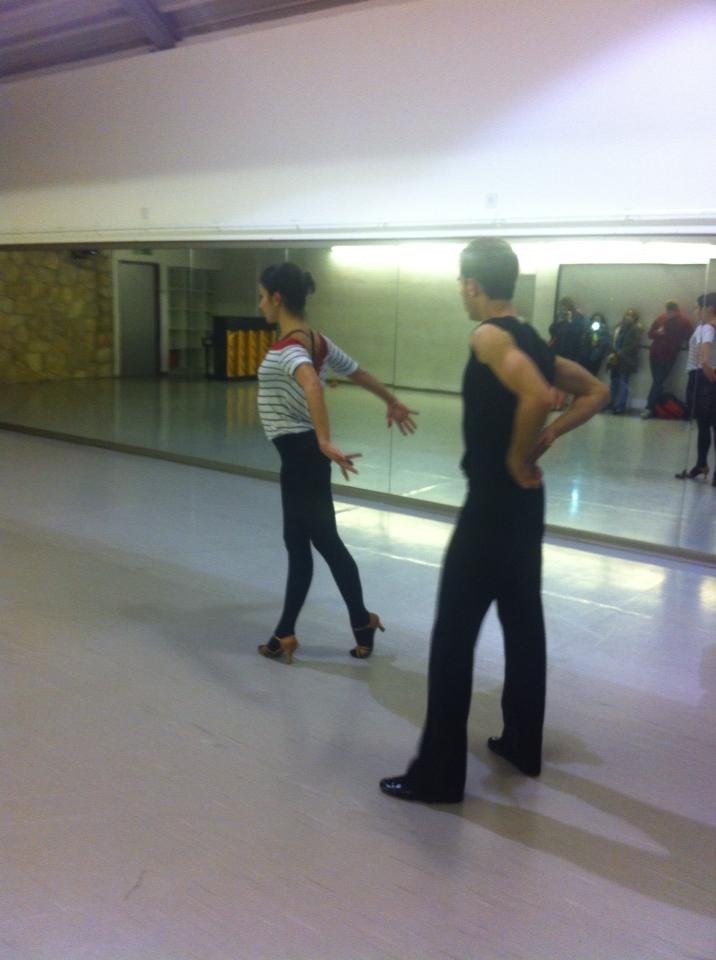
Today we traveled from Tiberias to Haifa, another city nearby. In this city we explored a number of educational institutions, one being the Jerusalem Music Academy where we observed a Salsa class! Instead of simply observing, myself and a couple of other participants decided to join the dancing, which was really fun. The class was practicing their "circle dance" which is a type of dance very popular in Cuba! Having already done this in France, it was so comforting to be able to participate in the class with this shared similarity. As I was dancing with the Israeli dance students we were really interacting through our hand movements, our eye contact, and our smiles. Despite the fact that we were not the same, we were communicating and enjoying dance. We were speaking all the same moves...dance is really a universal language! I appreciated this experience because it was an aspect outside of military and politics, but it is just as important to the education and culture of the Israelis.


Monday, January 7, 2013

Caravan for Democracy Mission - A better understanding

January 5, 2013 

Today we had a walking tour of Jerusalem in the rain and it was quite an experience. 

I went into a mosque and was moved by the number of Muslims that congregated to pray together in the heart of Israel. Although there is a lot of tension among the Jews and Arabs in Israel, it was an eye opening experience to see how the two groups are able to coexist. Much of the media permeated in the US makes it seem as through the Jews and Muslims hate each other and are unable to live peacefully together but I was able to see first hand how this is not true. 

I also appreciated going to the film school and watching movies about tangible issues that the people of Israel have to face including homosexuality and the security barrier. Although the security barrier makes life harder for many Palestinians, it was not done to segregate two peoples; it was a measure taken by the government to combat the bombings that were becoming all too common in Israel. Before this journey, I was very critical of the wall and did not agree with its presence but now I understand that it was necessary for security reasons. I also have a better understanding of the geopolitical issues that Israel faces and can speak more intelligently about why certain things are the way they are in Israel. 

This is why I am extremely thankful for this experience and look forward to telling my peers and colleagues about all the new things I have learned during this incredible journey. 

Sincerely,
Shabhia Akter