Monday, October 14, 2013

An inclusive Bat- Mitzvah trip to Israel

Yardena and Geoffrey Miller from Woodmere, NY could not have asked for a better way to celebrate their daughter Sigal’s bat mitzvah than with a family trip to Israel. The Millers did not want to compromise on this trip in any way, even though Sigal is in a wheelchair.

It was important for them to be able to see and experience everything they wanted to in Israel, without leaving Sigal behind. Since no trip to Israel is complete without a hike or nature outing, the Millers knew that they would have to find such an activity where Sigal could be included. Thanks to the Jewish National Fund and the nonprofit organization LOTEM- Making Nature Accessible, this was possible.

The Miller’s trip to Israel culminated with a visit to LOTEM’s ecological farm and hiking trail located in the north of Israel, outside the city of Yokneam. The Millers were greeted on the farm by Raz, a national service guide with LOTEM. Raz was injured 10 years ago in a car accident, leaving him paralyzed from the neck down. Raz led the Millers in an activity where they got to make perfume from hand-picked herbs. A group of teenagers from the Bet Eckstein School for special education in Pardes Hana who were on a fieldtrip with LOTEM that morning then threw a surprise party for Sigal. They presented her with a birthday cake and surrounded her in song. It was very moving for the entire Miller family.

Sigal and Lotem guide Raz Photo: Lotem
Sigal and Lotem guide Raz (Photo:Lotem)
After the bat mitzvah celebration, the Millers hiked LOTEM’s all-inclusive trail in the KKL-JNF Nahal HaShofet Nature Park. This fully accessible trail is the only one of its kind in Israel. Raz led the Millers on the hike and shared his story with them. When he was a young boy, he used to come to this nature park with his friends. Unfortunately after his injury, he no longer had a place where he can hike together with his friends. Thanks to JNF and LOTEM as well as other donors who funded the construction of an accessible trail in the Nahal HaShofet Nature Park, Raz and many others have a beautiful place where they can hike together and connect to the Land of Israel.

“It was a lot of fun”, Sigal’s fifteen year old brother Gabriel said after hiking with his sister. “It’s something I have not had the chance to do until now”.
SAMSUNG

“There are not many places where one can take a child like Sigal so it is special that we were able to come to Israel to celebrate as a family”, explained Yardena, Sigal’s mother. Sigal’s older brother Joseph added, “It’s important to include everybody”.

LOTEM- Making Nature Accessible is the leading organization in Israel offering accessible hikes and educational nature activities to people with special needs. A JNF partner organization, LOTEM brings the Land of Israel to all the people of Israel.
SAMSUNG

LOTEM also has a “Mitzvah-to-Mitzvah” program for bar and bat mitzvah youth to help them add meaning to their simcha. Bnai mitzvah can select LOTEM as their tzedakah project. On their next trip to Israel, they are invited to lead a hike or nature outing together with one of LOTEM’s soldier guides which culminates in a bar or bat mitzvah celebration on LOTEM’s farm.

To arrange a hike or nature outing with LOTEM on your next visit to Israel or to sign up for LOTEM’s Mitzvah-to-Mitzvah program, contact Alisa Bodner: 347-236-3262 or lotem@jnf.org.

Thursday, October 3, 2013

Israel’s fire scouts learn life skills while helping save lives


The volunteer program gives teens responsibility for handling essential firefighting tasks, propelling many to future careers.


Scouts at the Fire and Rescue training school in Rishon LeZion. Photo courtesy of JNF

Scouts at the Fire and Rescue training school in Rishon LeZion. Photo courtesy of JNF

Not long ago, a fire broke out at a tire factory in the Beersheva industrial zone. Five firefighters raced to the scene, accompanied by 11 Fire Scouts – high school volunteers trained to perform essential background tasks such as laying down hoses and keeping all firefighting equipment functioning properly.

“It was inspiring to see them go through the process and to know that eventually many of them will become firefighters,” says Ariel Kotler, development officer for the Jewish National Fund’s operations in Israel.

Spread the Word
The Fire Scouts program (Zofei Esh in Hebrew), was established in 1959 by the Israel Firefighters Rescue Service. In 2003, the JNF partnered with Friends of Israel Firefighters (FIF) to provide practical and financial support for the program.

As the Beersheva scene suggests, Israel’s Fire Scouts is not exactly equivalent to Fire Department Explorer programs for American and European youth. Firefighters at every one of Israel’s 103 fire stations depend on Fire Scouts to take care of critical tasks at a safe distance from the front lines.

“In Israel, there is one firefighter for every 7,500 thousand people, as compared to one for every 1,000 people in the United States,” says Yael Levontin, liaison between JNF and FIF. “There is a lack of manpower, so the Scouts are part of the integral system.”
Better citizens, better people
Fire Scouts is one of the community-service choices available to every high school student beginning in 10th grade. About 1,500 Israeli teens are involved in the movement this year.

“It instills the value of helping others, shaping them into better citizens and better people,” Levontin tells ISRAEL21c. “They experience success and failure and teamwork.”

Many more boys and girls apply than can be accepted. An interview process determines if they have the right stuff for the difficult job of assisting at fire and accident scenes.

“We’re teaching these kids to run into a place that we’re teaching everyone else to run out of,” as Kotler puts it. “They have to be capable and courageous.”
In many Israeli communities, teens at risk receive special consideration as Fire Scouts. “A lot of the kids come from places where they don’t have anything productive to do after school, and instead they are taught about taking responsibility and they become part of a bigger community,” says Levontin.
“For kids from problematic homes, the firefighters are good role models and ‘big brothers.’ The program gives meaning to their lives and has a major impact,” Kotler tells ISRAEL21c.

Fire ambassadors

During 50 hours of training at their local fire stations, scouts learn to operate fire trucks, ladders and hoses, as well as rescue techniques. They study how fires begin, spread and are extinguished, and how to handle gas leaks and dangerous chemicals.

Fire Scout Eliana Lewis at Neot Kedumim nature reserve. Photo courtesy of JNF
Fire Scout Eliana Lewis at Neot Kedumim nature reserve. 

“After basic training, they are required to volunteer once every two weeks at the fire station, but I haven’t yet met a Fire Scout who doesn’t come more often,” says Kotler. “There is an adrenalin rush and an amazing feeling of riding on a fire truck, going to save lives, and then leaving the scene knowing you made a difference.”

According to Fire Scout Aryeh Levinson, 18, “It’s like a family there, and you feel you’re really doing something – you’re not just watching.”

Levinson began Fire Scouts with 10 boys from his sophomore class in Jerusalem, serving at two different stations over the next three years and helping out with house fires and forest fires. “A forest fire is scary but I didn’t feel I was in danger,” says Levinson, who emigrated with his family from New York seven years ago.

Now he is in a hesder yeshiva (combining army service and learning) in Sderot, and plans to continue volunteering at a fire station there. Eventually, he wants to be a firefighter. A couple of Israel’s current regional fire chiefs began as Fire Scouts.

In addition to ongoing training, scouts help patrol and secure large gatherings such as Independence Day celebrations. They also serve as “ambassadors” at school or community fire safety-education events.

Scouts save the day

Team Commander Shimon Chaim, a firefighter who supervised scouts for the last four years in Jerusalem, says the capital city’s 130 professional firefighters are assisted by more than 90 Fire Scouts.

“We make them into good people and good citizens. They’re not hanging out in the streets,” he tells ISRAEL21c.
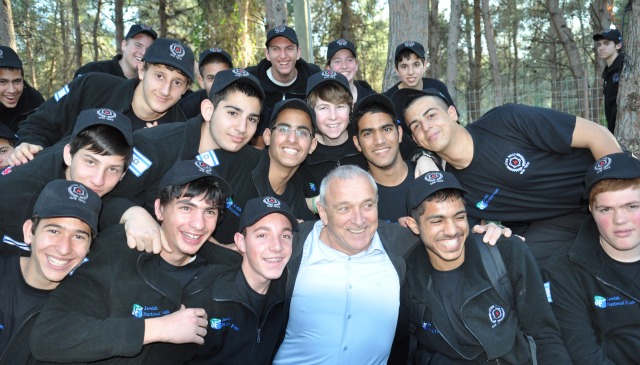
Fire Scouts with Minister of Public Security Yitzhak Aharonovich at an awards ceremony after completing training. Photo courtesy of JNF
Fire Scouts with Minister of Public Security Yitzhak Aharonovich at an awards ceremony after completing training. 

In July 2010, a blaze in the Jerusalem Forest brought out firefighters from all six local stations, leaving few firefighters to handle other calls. When the Romema station was alerted to a house fire, the skeleton crew responded along with a team of Fire Scouts.

“They saved the day,” Chaim says. “They laid out the hoses and worked the pumps so the firefighters could go into the burning apartment, where they saved two 18-month-old babies. I don’t want to think about how it would have ended if not for the Scouts.”

One incident did not end as happily. In December 2010, Elad Riven, a Fire Scout from Haifa, saw the smoke of the Carmel Forest fire and left school to run and help. The uniformed 16-year-old soon came across a burning bus filled with Prison Service cadets going to evacuate a nearby jail. Tragically, Elad lost his life trying to save the cadets, 40 of whom died.

Following this disaster, the JNF and FIF stepped up their participation in the training and equipping of the Fire Scouts. Today, the teen volunteers are taken on heritage trips around Israel to better understand the land they are protecting, and their new uniforms make them more easily differentiated from professional firefighters.

Fire Scouts can connect through a Facebook page, and take part in monthly meetings and evaluations with their mentors.

“It gives us a lot of pride knowing we are training the next generation of firefighters,” says Kotler. “And it’s not just about that, but about being better people and giving rather than taking.”

TWO VENERABLE INSTITUTIONS UNITE, SHARE VISION FOR A BOLD FUTURE


AMHSI2.jpgOctober 2, 2013 -- New York, NY -- Zionism claimed a victory this week when Jewish National Fund (JNF) announced a new and expanded partnership with the Alexander Muss High School in Israel (AMHSI). Pursuant to an agreement unanimously approved by both JNF’s Board of Directors and Board of Trustees as well as by AMHSI, JNF will appoint all members of AMHSI’s Board of Directors and integrate AMHSI’s operations into JNF’s broad array of educational initiatives.
“Many people in the Jewish world today – even the most committed – are afraid of the ‘Z’ word: Zionism,” said JNF Chief Executive Officer Russell F. Robinson. “Not Jewish National Fund. It is part of our everyday vernacular -- whether we speak to young or old, whether we are talking about our work in Israel or our Zionist educational activities here in the U.S., when we refer to our rich history and when we speak about our vital and promising future. This enhanced partnership between JNF and AMHSI will catapult Zionist education to the next level.”
As the single largest provider of Zionist education in the U.S., Jewish National Fund offers myriad ways to connect young American Jews to Israel – from trips to b’nai mitzvah projects to education and advocacy programs.
For over 40 years, AMHSI has led the field in providing transformative pluralistic Israel experiences for high school students. AMHSI has developed fully accredited academic programs for teens to strengthen their Jewish identity while developing deep-rooted connections to Jewish life, to the Jewish people, and to Israel. Today, the school has more than 20,000 alumni – many of whom are active leaders in their Jewish communities.
While JNF and AMHSI have enjoyed a long-standing partnership, both JNF and AMHSI see this new relationship as greatly beneficial to the greater Jewish community.
“As the parent of two children who attended a semester program at the Hod Hasharon campus,” said Joseph Wolfson, Assistant Vice President of JNF and member of the AMHSI Board, “I know that AMHSI provides a unique experience for children to learn about the history of the Jewish people, our connection to the Land of Israel, and our Zionist heritage. JNF, being the original Zionist organization and having a broad array of Zionist education initiatives, is a natural partner for AMHSI. When the opportunity for JNF and AMHSI to work even more closely arose, I was an immediate supporter, and our review and work to bring together the relationship only reinforced my view. I am excited about the possibilities we have to work together and look forward to great success. I know that this partnership can have a lasting and enormous impact on the next generation of Zionist leaders.” 
“All through the years I have had great respect for the activities of Jewish National Fund,” said Stephen Muss, Chair of AMHSI. “JNF is famous for planting millions of trees, water conservation, and dedication to Israel and the Negev. JNF and AMHSI have had a growing relationship over the years that has led to the Board of Trustees of both JNF and AMHSI to approve an even greater integration of AMHSI, so that both organizations can consolidate their educational efforts and we can focus on what’s important: teenage Israel experience, Jewish continuity and Zionist education.”
Orit Rome, newly named AMHSI Co-Executive Director who has served in many roles including Chief Financial Officer and Chief Operating Officer, will now work in partnership with the new Co-Executive Director, Rabbi Leor Sinai.
Leor made Aliyah with his family in June 2011. His professional resume includes the Dan Hotels of Israel, Jewish National Fund, The Jewish Lens, Hillel Israel, and The Jewish Agency for Israel. Leor was ordained in 2009 at The Jewish Theological Seminary and works passionately to build networks of Jews worldwide with Israel at their center. 
Leor and Orit will run the day-to-day operations of the school, managing the marketing, fundraising, education, finances, facilities, and overall administration. Rabbi Philip Nadel will continue as the head of the school, doing an outstanding job of keeping AMHSI’s educational standards at a very high level.
“We are all about growth and about the development of the next generation of leaders,” said JNF Chairman of the Board Ronald S. Lauder. “AMHSI is the leading high school program in Israel and we take great pride in the knowledge that our oversight and operation of AMHSI will help ensure another generation of students. We believe in it – in its history and its future. We have a moral obligation to make sure the school continues to thrive. And we will.”
“When I was at Muss,” said Matisyahu, popular musician and Sept. ’95 alum, “it was probably the first time in my life that I felt that being Jewish was something that was important and there was something to be discovered.”
Said AMHSI alum (June ’82) Wayne Firestone, former President and CEO of Hillel: The Foundation of Jewish Campus Life: “AMHSI is a program that speaks in such universal terms to all young people and allows them to have an intellectual and personal connection to explore their Jewish identities.”

Wednesday, September 11, 2013

The Modern Miracle of Sukkot


The yellow fruit dominates the landscape as far as the eye can see and a lemony aroma wafts across the fields. But what has become the norm for this time of year was nothing but barren desert just a few short years ago.

They are the etrog fields of Halutza and represent modern day pioneering at its best.

Born in the Sinai settlement of Yamit before her family was evacuated in 1982, Moriah Gottlieb grew up in the desert community of Gush Katif. By the time the community was evacuated from the Gaza Strip in 2005, she was living in Jerusalem with her husband. But when the evacuees established the new community of Halutza, she and her husband joined these modern-day pioneers, who have made the desert bloom as farmers of the etrog, a little citrus fruit with important religious significance. “To build Jerusalem,” she said, “you need to build the rest of the land; this is an extension of Jerusalem.

“With my husband’s love for farming, my childhood in Gush Katif, and my family’s evacuation from the Gaza strip, we felt that we had to join and show support,” Moriah said. “We came to this area in solidarity and to establish a plantation of etrogim in the sand.

“It was not clear what would happen after the disengagement,” said Moriah. “But here in Halutza there was a great vision. There were no sad and depressed people. Here people came to continue developing the country and to work in agriculture. That is what attracted us to join the community.”

Her husband’s family, the Gottliebs, had been growing etrogim in the Jordan valley for decades. The couple transported tiny cuttings to their new home hoping that they would grow, which seemed near impossible in such a barren land. But as her and her family nurtured these vulnerable plants something amazing began to happen: shoots began springing up, filling not just one orchard, but many, creating a swirling sea of green on a dirt yellow backdrop.

As the roots took hold, Moriah and her husband were reminded that they themselves were laying the roots for the future generations of Israel, fulfilling the Zionist dream of Torah and working the land. They themselves are the pioneers. Now, the Gottliebs produce roughly 25,000 etrogim a year. Due to the seven levels of etrog perfection, which determine whether an etrog is kosher, roughly 40% of these etrogim are thrown away. Out of the remainder, the majority is exported to the US and the best ones dedicated for community rabbis.

The Halutza community has started attracting families from all over Israel who are recognizing the area’s potential and its unique qualities.

As part of its Blueprint Negev campaign to sustainably develop the Negev Desert and increase its population, Jewish National Fund (JNF) is supporting the expansions of the new communities of the Halutza region. JNF has supported Halutza’s growth from the beginning by clearing land for housing and farming, purchasing temporary prefabricated homes, laying basic infrastructure, and paving roads. As the region expands, JNF is helping residents to re-establish their social and educational institutions, construct public buildings, and create green spaces. A new yeshiva, beit midrash (study hall), synagogue, kindergarten, park, and playground have been established with JNF’s support, and many more facilities are on the drawing board.

The Gottliebs lived in a caravan for five years with their seven children, waiting for a housing lot. They have been in their new house for two years. Perhaps the most poignant part of Moriah’s story is the location of her new home: at the end of the road. Two sides of her house are filled with windows that open onto the desert views and right in the middle of her view are her orchards.

“When I look out the window and see the etrogim,” she said, “I know why I’m here, I know my purpose.”

Tuesday, September 10, 2013

Clean Up the World Day


Dear JNF USA Friends,

International Clean Up the World Day took place yesterday. Thanks to the JNF USA support, new immigrants (adults and children) Ethiopia came from 17 different absorption centers in Israel and enjoyed the activities. 

This educational program is a very important and meaningful experience for the participants and their feedback reflects that! 

Below are photos from the activities that took place yesterday at one of the absorption centers in Tzfat.

As you can see, they had a great time! Thank you for helping to raise their awareness about the importance of respecting our environment.  I am sure they will never forget this special day.  It was a wonderful way to start the new year!


Wednesday, September 4, 2013

Date and olive pits dispel mystery of King Solomon’s mines

Reposted from Ha'aretz

The copper mines at Timna were long thought to have been operated by Egyptians in the 13th century B.C.E., but organic remains now show that they reached their prime during the reign of King Solomon, three centuries later.

By Nir Hassan 

It took 10 date pits and one olive pit to come to the conclusion that the heyday of the copper mines at Timna, near Eilat, was indeed during the reign of King Solomon, in the 10th century B.C.E. 

The samples, which were dug up by a Tel Aviv University team headed by archaeologist Erez Ben Yosef, were sent to Oxford for a carbon-14 dating test. The results proved that the site wasn’t populated during the 13th century B.C.E., as previously thought, and that its peak of activity was actually some three centuries later. 

But King Solomon had in all likelihood no connection to the mines, although they are called after him. The site at Timna, says Ben Yosef, resembles the copper refinery in Faynan, in Jordan, which probably means that the mines were operated by the Edomites, who lived on the eastern bank of the Jordan River, and not the illustrious king of ancient Israel. 

In recent decades scientific consensus has been that the mines were operated by the Egyptian Empire that ruled the area in the 13th century B.C.E. This notion was the result of excavations carried out at Timna by the pioneering Israeli archaeologist Beno Rothenberg, who discovered in 1969 a small and beautifully preserved Egyptian temple. Until then, it had been universally accepted that King Solomon operated the mines. The current mission turned the tables again and set the operation date of the mines back to the era of King Solomon - but the king’s degree of involvement is yet undetermined. Ben Yosef says that he could not dismiss the possibility that the Edomite kingdom was subjugated, to some extent, to the Judean Kingdom, through a representative sent from Jerusalem, as stated in the second Book of Samuel. 

The excavated area is known as "Slaves' Hill," as the American archaeologist Nelson Glick, the first to preside over excavations at Timna, called it. He believed that a wall built around the hill was meant to prevent the slaves working in the mines from escaping. The recent excavations seem to refute this thesis as well, revealing an unprecedented wealth of organic findings – fabrics, ropes, seeds (including wheat, barley, pistachio, grapes, dates and olives), and animal bones - that were preserved in excellent condition due to the extremely dry climate in the area. The bones and food remnants, explains Lidar Sapir-Hen, an archaeozoologist at Tel Aviv University, suggest that the workers were better fed than most residents of the region at the time. "This also conforms with other findings from other sites that prove that copper diggers were considered important craftsman, almost priests, who knew how to produce new material: metal from stone," Ben Yosef says. 

Ben Yosef is also set to refute an archaeological convention whereby only civilizations that left architecturally impressive structures could be considered as sufficiently developed to establish and maintain an economic and engineering operation of the scope of the Timna mines. "It was a society that mostly lived in tents, but still had impressive military power, since it was necessary to protect the copper mines," he says. 

The findings also allow researchers to determine that the mines were abandoned at around the end of the 10th century B.C.E. Ben Yosef believes that the mining operations were stopped as a result of a military invasion by King Shishak of Egypt, in 925 B.C.E. Still, copper production continued, using different, more advanced technology, for another century or so. In the 9th century B.C.E. all production was halted for a long period, probably due to the import of cheaper and higher-quality copper from Cyprus.

Tuesday, September 3, 2013

Op-Ed: Why don't Rabbis for Human Rights care about Bedouin women?

Reprinted from HAARETZ

Monday, September 02, 2013 Elul 27, 5773

by Professor Alon Tal

Last month a conference was convened in Be'er Sheva to consider the issue of domestic violence in the Bedouin sector. A recent report prepared by the Bedouin chapter of Women Lawyers for Social Action describes a horrifying situation: 79% of Bedouin women have been attacked by their husbands. 90% describe an ongoing pattern of violence and harassment that they have suffered over their lives by virtue of their being women. Some 80% are afraid to leave their homes without a male escort, for fear of the resulting retaliation. Polygamy has become so widespread that a majority of Bedouin children in the Negev have siblings from a mother different than their own. Most of the speakers were Bedouin women, but the conference was conducted in Hebrew so that Israel's Jewish majority could be informed. Representatives from many public interest groups were there, as were several academics and feminist activists. They were both appalled at the government's failure to provide protection to its citizens and impressed by the courage of the women who are finally standing up and calling for change. One organization that purports to speak for the Bedouin was conspicuously absent: Rabbis for Human Rights.

Instead, this organization continues to focus its energies in the Negev in supporting a campaign of a few Bedouin families to receive ownership of lands they claim belonged to them over sixty years ago The El-Araqib area, located just to the south of Rahat, has been in the news intermittently. Israeli courts hear legal petition after petition by the families in their attempts to annul an order from the 1950s that brought these open spaces into the public domain. Consistently, a range of judges were not convinced by the testimony about historic ownership and called the violent behavior of the petitioning Bedouin families into question.

I have met with the leaders of the El-Araqib campaign and also did not found the evidence they presented compelling. Aerial photographs from the past century tell a very different story. And I trust Israel's legal system to offer the petitioners a fair day in court.

At the same time, I recently taught a university course about environmental justice that focused on Rahat, the largest Bedouin city in Israel – and the Negev's second largest town. So I am very familiar with the crowded conditions and the desperate need for open spaces by residents of the city. Even if I did think the petitioning clans had lived there from time immemorial, even a teaspoon of utilitarian justice requires the preservation of these open spaces to ensure that the citizens of Rahat city today and the future enjoy a green belt around their city.

The regional master plan which is being implemented is designed to prevent an urban sprawl that would connect Be'er Sheva and Rahat. It makes total ecological and sociological sense. If new evidence convinces the courts that there are historic claims, financial compensation can and should be paid to the El-Araqib petitioners. To allow construction there would be a mistake.

Last week I saw a mass email sent out by Rabbis for Human Rights to their extensive list comparing the intrepid El-Araqib campaigners to Martin Luther King's battle for justice. It is time to bring a little sanity into the discourse. The controversy surrounding El-Araqib has absolutely nothing to do with the civil rights campaign of fifty years ago. To invoke the heritage of great Rabbis like Abraham Joshua Heschel's or Jacob Rothschild's involvement with Dr. King is not just historically imprecise; it is downright disingenuous.

To begin with – the level of violence associated with the El-Araqib campaign is enormous. Some 65% of the grazing that survives among Bedouin herders takes place in JNF forests. As Bedouin communities have practically no parks, the Negev forests are increasingly becoming sanctuaries for Bedouin recreation and celebrations. Yet, the foresters of the JNF have been attacked on innumerable occasions, their vehicles torched and their lives threatened by the small minority of Bedouin who oppose the afforestation work there. For Martin Luther King, non-violence was axiomatic.

Martin Luther King sought justice for his entire people and did not focus his energies on a real estate bonanza for his extended family. If Rabbis for Human Rights succeeds in its campaign, it will means that the 50,000 residents of Rahat – (soon to be 100,000) - will be suffocated to the south by the expansive homesteads of the present protesters, who received a substantial real estate prize for their lawlessness. There is a major debate in Israel surrounding the dimensions and conditions of the proposed land arrangement for the many "unrecognized" Bedouin villages. If lands are the concern, this is the macro-issue which should be the focus of discussion, not this very local maneuver for private property.

Martin Luther King spoke on behalf of the discrimination that left the African-American community poor and disadvantaged. There is nothing in the present campaign that goes to the critical issue of creating economic opportunity for Israel's poorest citizens. The people fighting for El-Araqib are not homeless or indigent. The protesters' houses in Rahat, some of them impressive villas, may be crowded because of their large families. But the issue is surely not a question of providing a roof for homeless refugees.

It is most infuriating to have the Rabbis for Human Rights campaign focus so much of its energies on discrediting the Jewish National Fund. Like the other 8% of Israel's woodlands, the trees planted by the JNF in the Negev prevent erosion, enrich the soil and create recreational sanctuaries for all Israeli citizens. Surely, the Bedouin community deserves its fair share of accessible forests. It seems to me that there are real human rights violations in the Negev besides important land reclamation that need to be targeted.

As part of my research, last month I met separately with the mayors of the leading Bedouin cities of the Negev. Not one was willing to express solidarity with the campaign to privatize El-Araqib. In contrast, they all told me that one of the only non-government organizations that actually helps them in their tireless efforts to improve the quality of life for the Bedouin is the JNF. Indeed, two had even gone on fundraising and promotional campaigns for JNF expressing appreciation for its assistance in building parks, restoring river ways and building one of Israel's most ambitious sustainability centers in Wadi Attir. One of the mayors referred to El-Araqib backers as disloyal to the country – and out of touch with the real needs of the Bedouin.

I am proud that there is an organization of rabbis who feel that Jewish tradition has something to say about human rights and I salute it in its overall mission. In the case of Israel's Bedouin community, however, where violation of human rights is so rampant, their agenda seems confused and their energies seem to be misplaced. is time to respect the integrity of Israel's court and existing legal proceedings and move on to the real human rights nightmare facing scores of women in the Negev. The Bedouins of Israel really do need the assistance of Rabbis for Human Rights. Let's hope that they start to receive it.

Professor Alon Tal is on the faculty of Ben Gurion University and on the international board of the Jewish National Fund.